If you've ever wondered what makes a skincare product actually work, the answer almost always comes down to its active ingredients. These are the powerhouse components, backed by science, that are proven to create a real, physical change in your skin.
They're the star players in any formula, the ones responsible for tackling your biggest concerns-like fine lines, stubborn acne, or hyperpigmentation-and delivering the visible results you’re looking for.
Understanding the Role of Active Ingredients
Think of your favorite serum as a chef's special dish. The active ingredients are the main event-the salmon, the Wagyu, the truffle-that defines the entire experience and delivers the flavor you came for. They are the ingredients that are biologically active, meaning they get down to business and interact directly with your skin cells.
Everything else in the bottle is considered an inactive ingredient. Don't get me wrong, these supporting elements are crucial. They create the product's silky texture, keep it stable and safe, and help deliver the actives effectively so they can do their job.
These supporting cast members include things like:
- Emollients (like shea butter) to soften and smooth the skin’s surface.
- Humectants (like glycerin) that act like little magnets, pulling moisture into the skin.
- Preservatives to stop nasty bacteria or mold from setting up shop in your jar.
- Emulsifiers that work tirelessly to keep the oil and water components from separating.
Why Actives Are Key to Your Skin Goals
While the inactive ingredients make sure the product feels elegant and stays fresh, it’s the active ingredients that truly determine whether it will help you reach your skin goals.
Want to brighten up a dull, tired-looking complexion? You'll need a product with an active like Vitamin C. Looking to smooth away fine lines and improve texture? Your best bet is a retinoid.
This is why understanding what active ingredients do is the first step toward building a routine that actually gets you results. It empowers you to see past clever marketing and choose products based on what’s scientifically proven to work. This very philosophy is at the heart of Korean skincare, which we celebrate here at Mirai Skin. K-Beauty excels at creating brilliant formulas that balance potent actives with gentle, skin-soothing ingredients for incredible results with minimal irritation.
This is the core of smart skincare: matching the right active ingredient to your specific skin concern. When you know what each active does, you hold the power to build a routine that truly works for you.
To get you started, here is a quick-reference guide to some of the most popular and effective active ingredients out there. Think of it as your cheat sheet for decoding any ingredient label.
A Quick Guide to Top Active Ingredients
| Active Ingredient | Primary Function | Best For Skin Concerns |
|---|---|---|
| Vitamin C | Potent antioxidant, collagen booster, brightener. | Dullness, uneven tone, dark spots, fine lines. |
| Retinoids | Increases cell turnover, boosts collagen production. | Wrinkles, acne, uneven texture, sun damage. |
| Niacinamide | Soothes, strengthens skin barrier, regulates oil. | Redness, large pores, acne, hyperpigmentation. |
| AHAs & BHAs | Exfoliates dead skin cells. | Clogged pores, rough texture, acne, dullness. |
| Hyaluronic Acid | Deeply hydrates and plumps the skin. | Dehydration, dryness, fine lines from dryness. |
This table covers the heavy hitters, but the world of actives is vast and exciting. Knowing what each one does is like having a superpower when you're navigating the skincare aisle.
Meet the Powerhouse Skincare Actives
Now that you know what separates an "active" from an "inactive" ingredient, it's time to meet the true titans of the skincare world. These are the clinically-backed, results-driven components that form the foundation of any truly effective routine. They aren’t just trendy buzzwords; they are the workhorses that deliver visible, science-proven change.
In K-Beauty, these power players are often combined with innovative delivery systems and soothing botanicals to boost their benefits while keeping the skin barrier happy and healthy. This sophisticated approach is what makes brands like those featured on Mirai Skin so effective. Let’s dive into the most celebrated actives and see what makes them so special.
Vitamin C: The Master Protector
If your skin had a personal bodyguard, it would be Vitamin C. This celebrated antioxidant is one of the most researched ingredients out there, praised for its incredible ability to fend off environmental damage and bring back a youthful glow.
Picture your skin cells under constant attack from tiny troublemakers called free radicals, which are churned out by things like UV rays and pollution. Vitamin C swoops in like a shield, neutralizing these free radicals before they can cause oxidative stress-the process that leads to premature aging.
But its talents don't stop there. Vitamin C is also a critical player in producing collagen, the very protein that gives skin its firm, plump structure. By encouraging collagen synthesis, it helps smooth out the appearance of fine lines and wrinkles over time.
Key Benefits of Vitamin C:
- Brightens Your Complexion: It gets in the way of an enzyme needed for melanin (pigment) production, which helps fade dark spots and even out your skin tone.
- Provides Serious Antioxidant Defense: It protects skin cells from the damaging effects of daily pollution and UV radiation.
- Supports Collagen Production: It helps firm the skin and soften the look of wrinkles.
Vitamin C is a fantastic addition for most skin types, especially if you're dealing with dullness, an uneven tone, or the first signs of aging. You'll often find it in K-Beauty serums and ampoules, like those from our curated collection at Mirai Skin, designed to deliver a concentrated brightening boost.
Retinoids: The Gold Standard for Anti-Aging
When it comes to actually reversing the signs of aging, no ingredient family has more science behind it than retinoids. These are all derivatives of Vitamin A, and they work by essentially communicating directly with your skin cells, telling them to act like younger, healthier versions of themselves.
Think of it like a personal trainer for your cells. Retinoids push your skin to speed up its turnover rate, meaning old, dull cells are shed more quickly to reveal the fresh, new skin underneath. This process helps unclog pores, smooth out texture, and give your complexion a remarkable radiance.
At the same time, retinoids dive deeper into the dermis to kickstart the production of collagen and elastin. This helps rebuild the skin's supportive structure, leading to a visible reduction in fine lines and stubborn wrinkles.
Retinoids are true multi-taskers, tackling everything from acne to sun damage. Their ability to fundamentally improve how skin functions is why they remain the top recommendation for anyone serious about anti-aging.
Who Should Use Retinoids?
- Mature Skin: Unbeatable for targeting wrinkles, loss of firmness, and sun damage.
- Acne-Prone Skin: Excellent for keeping pores clear and reducing breakouts.
- Uneven Skin Texture: Helps create a smoother, more refined skin surface.
It’s crucial to start with a low concentration and use it only at night, as retinoids can cause some initial sensitivity and dryness. And remember, daily sunscreen is completely non-negotiable when using them, as they make your skin more vulnerable to the sun.
Niacinamide: The Ultimate Team Player
If retinoids are the powerful specialists, Niacinamide (a form of Vitamin B3) is the versatile, multi-talented team captain that gets along with everyone. It’s an exceptionally gentle yet powerful ingredient that addresses a whole range of skin concerns, making it a staple in countless Korean skincare formulas.
Niacinamide’s main job is to strengthen your skin’s natural barrier. A healthy barrier is like a well-built brick wall-it keeps moisture locked in and irritants locked out. Niacinamide helps your skin produce more ceramides, the "mortar" holding your skin cells together, making that barrier stronger and more resilient.
This barrier-boosting effect helps calm down redness and sensitivity, making it a hero for reactive skin. It also has the unique talent of regulating oil production, which helps minimize the appearance of pores and keep breakouts under control.
Why K-Beauty Loves Niacinamide:
- It’s incredibly versatile: It tackles pores, redness, oiliness, and hyperpigmentation all at once.
- It’s remarkably gentle: Suitable for nearly all skin types, including sensitive and rosacea-prone skin.
- It plays well with other actives: It can be used alongside ingredients like retinoids and Vitamin C to complement their effects and reduce irritation.
From toners and essences to serums and moisturizers, you'll find Niacinamide woven throughout the Mirai Skin collection. It's the perfect ingredient for achieving that balanced, calm, and clear "glass skin" look.
AHAs and BHAs: The Exfoliating Experts
To get truly radiant skin, you have to clear away the old, dead cells that pile up on the surface, causing dullness and congestion. This is where chemical exfoliants like Alpha Hydroxy Acids (AHAs) and Beta Hydroxy Acids (BHAs) shine.
Alpha Hydroxy Acids (AHAs), like glycolic and lactic acid, are water-soluble. This means they work on the surface of your skin. Think of them as a gentle polish that dissolves the "glue" holding dead cells together, sweeping them away to reveal a brighter, smoother complexion. They're fantastic for concerns like rough texture, sun damage, and hyperpigmentation.
Beta Hydroxy Acid (BHA), mainly salicylic acid, is oil-soluble. This special property allows it to travel deeper into your pores to dissolve the gunk-that mix of oil and dead skin-that leads to blackheads and pimples. BHA is the absolute go-to for oily and acne-prone skin.
| Acid Type | Works Best On | Primary Benefits | Common Examples |
|---|---|---|---|
| AHAs | The skin's surface | Brightening, smoothing texture, fading dark spots. | Glycolic Acid, Lactic Acid |
| BHAs | Inside the pores | Unclogging pores, reducing acne, controlling oil. | Salicylic Acid |
Korean Beauty often incorporates these acids into gentle toners or pads. This allows for consistent, low-level exfoliation without the harshness of physical scrubs-a method that respects the skin barrier while delivering powerful clarifying results.
Hyaluronic Acid: The Hydration Hero
Finally, we have Hyaluronic Acid (HA), the undisputed champion of hydration. This ingredient is a humectant, which means it acts like a magnet for moisture. In fact, a single HA molecule can hold up to 1,000 times its weight in water, pulling hydration from the air and locking it deep into your skin.
Imagine a dry, shriveled sponge. When you add water, it instantly plumps up, becoming soft and bouncy. Hyaluronic Acid does the exact same thing for your skin, immediately softening fine lines caused by dehydration and giving it a dewy, supple look.
Dermatologists and skincare fans alike consistently praise these top-tier ingredients. Professional approval ratings really highlight their importance, with retinoids leading at 94 percent dermatologist approval. Following closely are niacinamide at 91 percent, hyaluronic acid at 89 percent, vitamin C at 87 percent, and salicylic acid at 85 percent, cementing their status as the most trusted actives in skincare. You can learn more about how dermatologists rate these skincare superstars and why they're so effective.
Because it's something our bodies naturally produce, Hyaluronic Acid is well-tolerated by everyone. Whether your skin is dry, oily, or sensitive, it can benefit from the plumping hydration HA delivers. It’s a foundational ingredient in many K-Beauty essences and serums available at Mirai Skin, designed to create that coveted hydrated, "chok chok" glow.
Meet the Supporting Cast of Your Skincare Routine
While powerhouse actives like Retinoids and Vitamin C get all the glory, they rarely fly solo. Behind every star player is a dedicated supporting cast-the unsung heroes that don't just complete a formula but elevate it, ensuring you get maximum results with minimal irritation. This is where the true artistry of K-Beauty formulations really shines.
These essential ingredients fortify your skin barrier, amplify the effects of the main actives, and provide the soothing care your skin needs to handle the heavy lifting. At Mirai Skin, we seek out products that master this delicate balance, creating gentle yet potent solutions for truly radiant skin.
Peptides: The Cellular Messengers
If actives are the workers, think of peptides as the project managers. These brilliant little ingredients are short chains of amino acids-the fundamental building blocks of proteins like collagen and elastin. When you apply them to your skin, they act like tiny messengers, signaling your cells to perform specific jobs.
For instance, some peptides can "tell" your skin to ramp up collagen production, helping to firm things up and soften the look of wrinkles. Others might focus on improving elasticity or even calming inflammation. This makes them a perfect partner for anti-aging actives like retinoids, as they work together toward a smoother, more youthful complexion.
Ceramides: The Barrier Guardians
Imagine your skin barrier as a brick wall. Your skin cells are the bricks, and ceramides are the mortar holding everything tightly together. Ceramides are lipids (fats) that are naturally found in your skin, making up a whopping 50% of its outer layer. They are absolutely critical for keeping that barrier healthy and resilient.
A strong barrier does two vital things: it keeps moisture locked in and keeps harmful irritants out. When you use powerful actives like AHAs or retinoids, they can sometimes temporarily weaken this barrier, leading to dryness, flaking, or sensitivity.
This is exactly why ceramides are such a crucial supporting ingredient. By replenishing your skin’s natural ceramide levels, they help:
- Strengthen the skin barrier, making it less susceptible to irritation.
- Lock in hydration, preventing the dryness often associated with strong actives.
- Soothe and calm the skin, ensuring your treatment is comfortable and effective.
Formulations that combine exfoliants with ceramides are a hallmark of smart K-Beauty design. They allow you to get all the glowy benefits of cell turnover without the uncomfortable side effects.
Think of it this way: using a retinoid without supporting your barrier is like renovating a house but leaving the doors and windows wide open. Ceramides are what secure the perimeter, keeping your skin safe, hydrated, and strong.
Antioxidants: The Environmental Defense Squad
While Vitamin C is the most famous antioxidant, it's just one member of a much larger family of protective ingredients. Antioxidants are molecules that defend your skin against oxidative stress caused by free radicals-unstable atoms generated by things like UV rays and pollution that damage skin cells and speed up aging.
Many supporting ingredients pull double duty as antioxidants, offering an extra layer of defense. They work to neutralize those pesky free radicals, protecting the integrity of your skin and even boosting the stability and effectiveness of other actives in your routine.
Common Antioxidant Allies:
- Ferulic Acid: Often paired with Vitamin C and E, it acts as a stabilizer, dramatically boosting their protective power.
- Ergothioneine: This clever amino acid helps protect other antioxidants from degrading, allowing them to defend your skin for longer.
- Green Tea Extract: A K-Beauty favorite, it's packed with polyphenols that soothe inflammation and provide potent antioxidant benefits.
When you pair these with your daily sunscreen, you create a comprehensive shield against environmental aging, keeping your skin healthier for years to come.
K-Beauty Botanical Actives: The Soothing Specialists
Korean skincare has a deep appreciation for the healing power of nature. Many beloved K-Beauty formulas feature botanical extracts that not only support the primary actives but often perform as gentle actives themselves. They are chosen for their unique ability to soothe, hydrate, and repair the skin.
Centella Asiatica (Cica) is probably the most famous of these botanicals. Often called "tiger grass," this powerful herb is renowned for its incredible calming and wound-healing properties. It's rich in madecassoside, a compound that helps reduce inflammation and redness, making it an ideal partner for potentially irritating ingredients. If your skin is feeling stressed from retinoids or acids, a Cica-infused cream can feel like a comforting hug.
Another iconic K-Beauty ingredient is Snail Mucin. This unique filtrate is naturally packed with a beautiful blend of beneficial components like hyaluronic acid, peptides, and antioxidants. It excels at hydrating the skin, promoting cell regeneration, and improving overall skin texture and tone. Its gentle, restorative nature makes it a perfect complement to any active-focused routine, helping to repair the barrier and boost radiance.
By integrating these supporting players, authentic Korean skincare from brands found on Mirai Skin creates formulas that are more than just a single ingredient. They are complete, thoughtful systems designed to deliver powerful results while nurturing the long-term health of your skin.
Building Your First Active Ingredient Routine
Knowing what active ingredients do is one thing, but actually using them correctly is the real game-changer. This is where knowledge turns into that visible, healthy glow everyone's after. Building a routine isn't about throwing every powerful product you can find at your face; it's about smart, strategic application that respects your skin's limits.
The core principle, especially celebrated in K-Beauty, is to start with a solid foundation. Before you even think about adding potent actives, make sure you have a gentle cleanser, a reliable moisturizer, and a daily sunscreen you genuinely enjoy using. These three products are the bedrock of any successful skincare journey.
Recent stats back this up, showing that moisturizers are used by 93% of consumers, with cleansers at 85% and sunscreens at 83%. Serums and exfoliators-the products that usually carry the active ingredients-are used by 57% and 55% respectively. It shows that most people build their routines from the ground up, and you can explore more of these skincare trends to see how your own habits stack up.
How to Introduce New Actives
The golden rule for adding any new active ingredient is simple: start low and go slow. This approach is your best defense against irritation, giving your skin the time it needs to acclimate.
Think of it like training for a marathon. You wouldn't just go out and run 26 miles on your first day, right? You’d start with shorter distances and build up your stamina over time. The same logic applies here.
A Step-by-Step Guide:
- Choose One Active: Don't try to introduce a retinoid, a Vitamin C serum, and an AHA toner all in the same week. Pick one new product and make it your focus.
- Patch Test: Before slathering it on your face, dab a small amount on a hidden spot (like behind your ear or on your inner arm). Wait 24-48 hours to see if any redness or irritation pops up.
- Start with Low Frequency: Begin by using the product just 2-3 times per week. If your skin is happy after a couple of weeks, you can slowly increase how often you use it. For heavy hitters like retinoids, you might even start with just once a week.
This careful process helps you figure out exactly how your skin is reacting to a new ingredient. If you get red or feel sensitive, you'll know the culprit right away.
Understanding Concentrations and Percentages
When you're trying to figure out what are active ingredients in skincare, the percentage on the bottle is a key piece of the puzzle-but it’s not the whole story. A higher number doesn't automatically mean a better product.
Effectiveness is all about hitting that sweet spot-the optimal concentration range for a specific ingredient, balanced within a great overall formula. For instance, niacinamide works beautifully between 2-10%, while a potent retinoid can be incredibly effective at just 0.3%.
Think of it like a recipe. You need just the right amount of spice to make a dish delicious; too much can ruin it completely. The best formulations, like those curated by Mirai Skin, use percentages that are clinically proven to work without causing unnecessary irritation.
This is where formulation synergy comes into play.
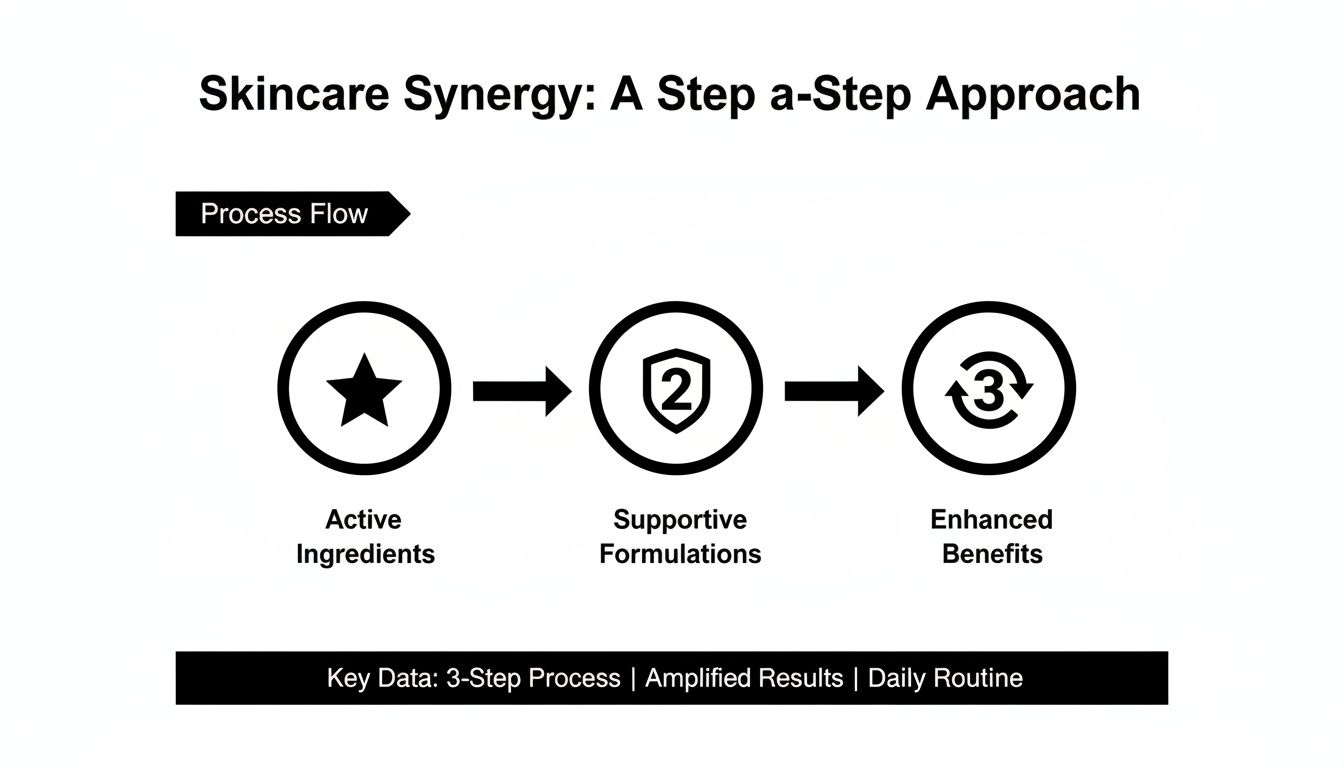
A great product doesn't just rely on the active. It combines that "star" ingredient with supportive, soothing ones to protect the skin and boost the overall benefits.
Layering Products For Maximum Impact
The order you apply your products really does matter. A simple rule of thumb is to go from the thinnest consistency to the thickest. This allows the lightweight, watery formulas to sink into the skin properly before you lock them in with heavier creams or oils.
A basic layering sequence looks something like this:
- Cleanser: Your essential first step to wash away dirt and oil.
- Toner/Essence: To hydrate and prep your skin for what's next.
- Active Serum(s): This is where your targeted treatments go.
- Moisturizer: To hydrate and seal everything in.
- Sunscreen (AM Only): The non-negotiable final step in your morning routine.
If you're using more than one active serum, apply the one for your main concern first. For example, if you're using a hydrating hyaluronic acid serum and a brightening vitamin C serum, let the vitamin C go on first to work its magic on your skin tone.
Sample Routines By Skin Concern
Seeing it all laid out can help connect the dots. Here are a few sample routines showing how you might layer actives to target specific goals.
| Skin Concern | Sample AM Routine | Sample PM Routine |
|---|---|---|
| Anti-Aging | Gentle Cleanser > Vitamin C Serum > Hyaluronic Acid Serum > Moisturizer > SPF 50 | Oil Cleanser > Water-Based Cleanser > Retinoid Serum (2-3x/week) > Peptide Moisturizer |
| Acne Treatment | Gentle Cleanser > BHA (Salicylic Acid) Toner > Niacinamide Serum > Lightweight Moisturizer > SPF 30 | Gentle Cleanser > Hydrating Toner > Niacinamide Serum > Spot Treatment (if needed) > Gel Moisturizer |
| Brightening | Gentle Cleanser > Vitamin C Serum > Niacinamide Serum > Moisturizer > SPF 50 | Cleanser > AHA (Glycolic Acid) Toner (2-3x/week) > Hydrating Serum > Moisturizer |
These are just examples, of course. The key is to listen to your skin and adjust based on how it responds.
The Essential Role of Sunscreen
Here's the hard truth: using powerful actives like retinoids, AHAs, and vitamin C without daily sun protection is like taking one step forward and two steps back.
These ingredients work by revealing fresh, new skin cells. That's great! But that new skin is also far more vulnerable to sun damage.
Sun exposure can completely undo all the benefits of your actives, leading to more hyperpigmentation, fine lines, and irritation. A broad-spectrum sunscreen with at least SPF 30 is your routine's most important insurance policy. It protects your investment and ensures all your hard work actually pays off. Don't skip it
How to Read Skincare Labels Like a Pro
Ever feel like you need a chemistry degree to understand a skincare label? You're definitely not alone. The key is knowing how to read the INCI list (International Nomenclature of Cosmetic Ingredients), which lists everything from the highest concentration down to the lowest.
This simple rule is a game-changer. The first few ingredients are the foundation of the product-usually something like water or aloe. The powerful active ingredients you're paying for are typically somewhere in the middle. And here’s a pro tip: anything listed after preservatives (like phenoxyethanol) is almost always there at 1% or less. It’s a quick way to see if a product is all marketing or if it actually packs a punch.
Decoding Popular Actives and Percentages
It’s tempting to think that a higher percentage automatically means a better product, but that's one of the biggest myths in skincare. True effectiveness comes from smart, clinically-proven concentrations, not just brute force. A beautifully formulated 0.5% Retinol serum can easily deliver better results-with far less irritation-than a poorly made 2% version.
The real magic is in the synergy between the active ingredient and its supporting cast. A great formula, like those you’ll find in the Mirai Skin collection, focuses on balance to deliver visible results while respecting your skin barrier.
This shift toward smarter formulas is why consumers are getting so savvy about specific ingredients. Salicylic acid, for example, is now the most-searched skincare ingredient in the world, pulling in an average of 60,500 searches a month in 2024. People want targeted solutions that work. Discover more insights about the top skincare ingredients of 2024.
This knowledge empowers you to see past the hype. Another common point of confusion is the difference between Retinol and its more intense, prescription-only cousin, Retin-A.
- Retinol: This is the gentler, over-the-counter version. Your skin has to convert it into retinoic acid to use it, which means it works more slowly but with way less irritation. It's the perfect starting point for most people.
- Retin-A (Tretinoin): This is pure retinoic acid. It's incredibly potent and works much faster, but it also comes with a much higher risk of redness, peeling, and sensitivity. That’s why you need a doctor's prescription to get it.
Once you understand these kinds of details, you can walk into any store and choose products that are genuinely right for your skin’s needs and tolerance levels.
Your Skincare Actives Questions, Answered
Jumping into the world of active ingredients can feel a little like learning a new language. As you start building a routine that works for you, some questions will definitely come up. Here are some clear, straightforward answers to the most common concerns we hear about.
Can I Use Multiple Active Ingredients at the Same Time?
Yes, you absolutely can, but it’s more about smart pairing than just mixing everything together. Think of it like a team-some ingredients work beautifully together and make each other stronger. For example, hydrating Hyaluronic Acid is the perfect partner for a retinoid, as it can help offset potential dryness. Another power couple is Vitamin C and Ferulic Acid; the Ferulic Acid actually helps stabilize the Vitamin C and boost its antioxidant power.
On the other hand, some combinations are better kept apart to avoid stressing out your skin. Using strong exfoliants like AHAs or BHAs in the same routine as a retinoid can be too much for many skin types, leading to irritation. A smarter approach, and one that's central to K-Beauty, is to alternate them. Use one in the morning (like Vitamin C) and the other at night (like a retinoid), or use them on different nights of the week.
How Long Does It Take to See Results from Actives?
This is where patience becomes your most valuable skincare product. While hydrating actives like Hyaluronic Acid or glycerin can give you an immediate plump, dewy look, the real work happening on a cellular level takes time and consistency.
Skincare is a marathon, not a sprint. Corrective actives that work on things like cell turnover, collagen production, or fading dark spots require dedication before you'll see a big difference.
For ingredients like retinoids, Vitamin C, or AHAs, you should plan on using them consistently for at least 8-12 weeks before you really start to judge the results. This gives your skin enough time to go through several renewal cycles, which is when the positive changes happening deeper down finally become visible on the surface.
What Is Skin Purging and How Do I Handle It?
Ever start a new active and suddenly get a crop of breakouts? That might be "purging." It’s a temporary reaction that can happen when you introduce an ingredient that speeds up cell turnover, like a retinoid or an exfoliating acid. It's basically pushing all the gunk that was already brewing under your skin's surface up and out, all at once.
It's most likely purging if:
- The breakouts pop up in the areas where you normally get them.
- The blemishes seem to appear and heal much faster than your usual pimples.
- The whole process should be over within one full skin cycle, which is about 4-6 weeks.
If you're breaking out in new places or it lasts longer than six weeks, it’s probably irritation or a bad reaction to the product itself. If that's the case, your best bet is to cut back on how often you use it or stop using it completely.
At Mirai Skin, we believe that understanding what are active ingredients in skincare is the first real step toward reaching your skin goals. Explore our curated collection of authentic K-Beauty products to build a routine that’s both gentle and incredibly effective.
Discover Your Perfect Skincare Routine at miari-skin.com